Cultivation of self in East Asian philosophy of education


Welcome to the special issue that focuses on the theme of self-cultivation in the East Asian philosophy of education. The cultivation of the self is always an issue of ultimate concern in the East Asian educational tradition. Thousands of years ago, Confucius, Mencius, Xunzi, Laozi, Zhuangzi and many other ancient philosophers all pondered on the meaning of being a person—what kind of a human being one should be and how one should develop oneself to be such a person. Their legacy has produced a unique domain of Chinese or Confucian cultural heritage in East Asia. The question concerning the self could be unpacked from different aspects. First, the tradition of Chinese philosophy has emphasised the emulation of model characters, including junzi (benevolent or noble person) and shenren (the sage), as the goals of education. However, some interesting questions are involved. Confucian and Daoist philosophers both adopt the term shenren, but they may have different references. Does the divergence lead to different educational ideas and practices? Moreover, what is the difference between self-conception in Confucian and Daoist traditions, and between them and Buddhist thought? Do the conceptions of junzi and shenren still affect current education in Confucian cultural heritage societies? Are these concepts still taken as the points of destination of modern education? On the other hand, it may be the case that the meanings of the conceptions of junzi and shenren are modernised in some sense. In this regard, the question of what change could be made in the understanding of self-conception and education has to be explored. Probing even further, the archaic conceptions of junzi and shenren could already be abandoned in modern times. Thus, what kind of human being is taken to replace the archaic conceptions as the destination of humanistic education in the modern era that is facing the thrust of globalisation and internationalisation? Expressed in a more radical way, do the descendants of Confucius, in blood or in spirit, still need an ideal human being for their education?

Second, the area influenced by the tradition of Chinese philosophy is much larger than China in the political-geographical sense. Local and temporal characteristics may produce differences in the conception of self in various regions. In the sphere of pre-modern Chinese cultural heritage, the ideal Confucian person had different names. In ancient China, the Confucian literati were called shidaifu. In Tokugawa Japan (1600–1868), they were called jusha; and in Chosen Korea, they were yangban (Huang, Citation2010).The different conceptions of the Confucian literati from various areas imply both similarities and dissimilarities, which indicate the complicated processes of how the Confucian human person is cultivated in each area with local characteristics.

The perfectibility of the human being as the cultivation of the self has been thought to be the common core value of the multifaceted East Asian Confucian humanism for a thousand years (Huang, Citation2010). This special issue’s eight-article collection addresses a wide range of issues in relation to self-cultivation from the East Asian perspective with diverse, creative and critical views.

Chi-Ming Lam’s ‘Confucianism and Critical Rationalism: Friends or Foes’ lends a new lens for viewing Confucianism. Lam compares Confucianism with rationalism and explores their differences and compatibilities. In the beginning of the article, Lam raises a very interesting question about whether or not Confucianism can be critical. As Confucius characterises the hierarchical structure of a harmonious society, it seems to suggest that Confucianism tends to cultivate ‘a conformist rather than critical mind’. However, Lam argues that in Confucianism, criticality plays a key role in self-cultivation. Confucius, Mencius and Xunzi all agree that a junzi should be critical to himself and others regarding learning. This interpretation may contradict our current understanding of Confucianism in relation to the concept of harmony. Since Hu Jintao, the former president of China, launched the new slogan, ‘harmonious socialist society’ in 2005 (Choukroune & Garapon, Citation2007; Doutournier & Zhe, Citation2009), the concept of harmony has been politicised. It is used as a means to silence different opinions in the society because a harmonious society is assumed to reach agreement or consensus rather than conduct debates. Lam has a very stimulating view about harmony: ‘So far as the role of criticism in Confucianism is concerned, it is to foster harmony between people of diverse backgrounds in the local and international community’. ‘Harmony in diversity’ is interpreted as the ultimate goal of Confucianism. This view is based on Confucius’ words: ‘The gentleman agrees with others without being an echo [heerbutong 和而不同]’. Here, Lam adopts Lau’s (Citation1992) translation of 君子和而不同. Nevertheless, Legge’s (Citation1861) translation reminds me of a different connotation: ‘The superior man is affable, but not adulatory’. Lau’s translation focuses on the substantial content of the agreement or the disagreement. In contrast, Legge’s translation stresses the person’s attitude or manner. Different translations have varying implications. On this point, I think there is still much to explore about the ‘diverse harmony’. Lam concludes with three major differences between Confucianism and critical rationalism and thereby suggests a possible reconciliation. Lam’s article shows the potential of Confucianism in the modern age in the sense that the goal of the Confucian self-cultivation is to create a person who practises not only ethical virtues, especially ren (benevolence), but also critical thinking.

‘Is Filial Piety a Virtue? A Reading of the Xiao Jing (Classic of Filial Piety) from the Perspective of Ideology Critique’ authored by Hektor Yan starts with a very fascinating question: Is filial piety a virtue? Among all virtues, filial piety is held in the highest esteem in Chinese culture and tradition. In imperial China, filial piety was one of the most important virtues for the ruler to justify his power to govern. Even in modern times, political leaders in Chinese heritage cultures still claim the importance of the Confucian virtues (de). A ruler with de would gain the people’s trust and support and win the consent and loyalty of his subjects. Yan applies Gramsci’s (Citation1992) insight on hegemony to de in the Chinese moral-political context to reveal that filial piety can be powerfully effective. Filial piety is generally understood as children’s obedience and servitude to their parents. In imperial China, it was extended to the subjects’ obedience and servitude to their rulers—in a blind and rigid way; therefore, it is criticised. By adopting Yu’s (Citation2013) view, Yan argues that filial piety can be a virtue ‘that requires critical reasoning and it is believed to be pertinent to various social roles and other interpersonal exchanges’. However, Yan acknowledges that the emphasis on critical reasoning is not easy to accommodate with another element of filial piety, which is the tendency of naturalisation. The author issues a warning in his conclusion. When the virtue of filial piety is taken as something natural to human society in a hierarchical way, it can function to maintain the hegemony of rulers.

Weili Zhao and Caiping Sun’s paper entitled ‘“Keep off the Lawn; Grass Has a Life Too!”: Re-invoking a Daoist Ecological Sensibility for Moral Education in China’s Primary Schools’ provides the introduction of Daoist ecological moral education in the modern world. The authors argue that the concept of co-being contributes to the formation of a Daoist ecological sensibility in children’s moral education. Their argument can be divided into two parts: the theoretical discussion and the analysis of textbooks. At the theoretical level, the authors use the popular park sign ‘Keep off the Lawn; Grass Has a Life Too!’ to demonstrate an age-old Chinese ecological and philosophical belief that human beings live harmoniously and equally with other living creatures on earth. This is a Daoist belief in the unity of human beings and nature. Zhao and Sun also employ Heidegger’s (Citation1969, 1977, 1978) relational thinking and the concept of co-being to enrich the Daoist ecological view. As the authors explain, the Daoist–Heideggerian idea of co-being can lend a lens to examine educational theory and practice. China’s 2002 Curriculum Standards and textbooks are the main subject matters of analysis. The analysis reveals that the ethical position implied in the standards and the textbooks is actually egoistic and instrumental, not reciprocal, egalitarian and interpersonal. Many educational materials claim environmental friendliness. However, as the authors aptly point out, such nature-friendly vocabularies hidden in the post-2001 textbooks assume a hierarchical and dominant thinking that human beings are the masters and owners of the natural environment. Thus, children are taught to build a relationship with others in the way of hierarchical subject–object duality, which is against the Daoist–Heideggerian ecological sensibility. However, the ecological-unfriendliness of the post-2001 textbooks was under review and revision. China’s primary school textbooks published in 2016 are redesigned, and the concept of ecological co-being is highlighted. The authors’ study shows that the tone of instrumental and subject-object oppositional thinking is minimised in the newly published textbooks and replaced with the accent of co-being. Phrases such as ‘playing with the wind’ or ‘thanking our Nature for giving humans presents’ are found in the textbooks. The implication is no longer the human-master but the co-existence of the human being and nature. Overall, this article presents a promising future of moral education with regard to the Daoist ecological sensibility in China.

Michael Dufresne’s creative article, ‘The Illusion of Teaching and Learning: Zhuangzi, Wittgenstein and the Groundlessness of Language’ shows the insightful communication between Eastern and Western philosophies that presents a new way of understanding teaching and learning. The author argues that the process of learning and teaching is not about transmitting knowledge but about cultivating contextually appropriate habits with the inspirations of Zhuangzi (Graham, Citation1989) and Wittgenstein (Citation1997, 2001). His article begins with Zhuangzi’s anecdote about Wheelwright Pian. Next, Dufresne poses a thought-provoking question about the possibility that there is nothing to be taught or learned in pedagogical practices. Based on Zhuangzi’s view, it is not possible to teach something to those who have no ‘knack’ for it. Dufresne points out that ‘only those who have the right “stuff” can actually be taught’. What is the ‘knack’ or the ‘right stuff’? Zhuangzi offers no clear answer. Dufresne relates Zhuangzi’s ‘knack’ to ‘sudden understanding’ in Wittgenstein’s words. According to Wittgenstein, there is no standard way of teaching and learning. Therefore, there is no rule to be taught or learned. One person cannot learn by following and applying rules because rules are open to interpretation. Furthermore, interpretation relies on words, that is, language, which is foundationless and groundless. Rather, language depends on the convention and the context. According to Dufresne, neither Zhuangzi nor Wittgenstein believes the essence of language or truth. The meaning of words always increase and change in various contexts. Overall, Zhuangzi’s ‘knack’ or the ‘right stuff’, or Wittgenstein’s ‘sudden understanding’ comes from ordinary daily language use, which is related to habit formation. Dufresne thus suggests that, for educators, it is more practical to provide learners with concrete examples and to help them develop appropriate habits than to teach them general rules.

Seungho Moon’s distinctive article, ‘Donghak (Eastern Learning), Self-Other, and Social Transformation: Towards Diverse Curriculum Discourses on Equity and Justice’ discusses the meaning of self-cultivation against the background of Donghak and its implications for contemporary curriculum theory. Donghak was a Neo-Confucian movement founded by Choi Je-u (1824–1864) in 1860 in Korea. Donghak, literally meaning Eastern learning as a reaction to Western learning, calls for both reform and revival of Confucianism. The doctrine of Donghak as an academic movement integrates ideas concerning theology, philosophy and social activism. Moon outlines Donghak by explaining three concepts: Shi-chun-ju (‘everyone serves God within himself or herself’), Sushim-junggi (self-cultivation) and Gae-byeok (building of a new world). The three concepts are indeed interrelated in the sense that the practice of self-cultivation is the process of serving God to attain the goal of building a harmonious new world—Dong-gui-il-che (the cosmological community). Based on this concept, Moon argues that the teaching of Donghak sheds light on examining the current curriculum in three aspects: the self-other hierarchical binary, the purpose of learning, and the eco-centred curriculum. As Moon explains, in the context of Donghak, everyone as a servant of the God is an equal part of the harmonious cosmological community. Donghak thus advocates equalitarianism, elimination of the selfishness of all, and ecocentrism: ‘The relations among God-human-nature-cosmos are conceived of as relationships of equals without hierarchal strata’. The ontological analysis in this article concludes with the emphasis on co-living and ecological vision for the curricular development of the twenty-first century. Overall, this article presents an overview of Donghak. For those who are unfamiliar with the development of Neo-Confucianism in Eastern Asia in modern times, this article does a fair job of introducing Donghak. Readers may find a strong bond between Donghak and religion. It is interesting to learn that the leader of the third-generation disciples, Son Byeong-hui (1861–1922), changed the name Donghak to Cheondogyo, meaning ‘Religion of the Heavenly Way’, whose doctrine combines Confucianism, religious Daoism (or Daojia) and Korean shamanism. Cheondogyo is still actively practised in modern Korea.

Joseph Sta. Maria’s ‘Acting Without Regarding: Daoist Self-cultivation as Education for Non-dichotomous Thinking’ draws attention to the significance of the Daoist non-dichotomous thinking and the ‘soft’ values. It is insightful for the author to highlight the tension between the ‘soft’ and the ‘hard’ values, or between the ‘higher’ and the ‘lower’ ones. In the Daoist tradition, it seems quite natural to accept the ‘soft’ values and take ‘passive’ attitudes. However, the author aptly pays attention to the Daoist dichotomy of being and nothingness. On one hand, Laozi claims that ‘being and nothingness give birth to each other’ (有無相生); on the other hand, he states, ‘Everything in the world is generated as being and being is generated from nothingness’ (天下萬物生於有,有生於無). The ‘soft’ values—‘nothingness’ and ‘weakness’—are described as the origins of movement and creation. This distinction is a paradoxical dichotomy in Daoist doctrines. As Sta. Maria notes, Laozi and Zhuangzi both assert non-dichotomous thinking as the ideal way of thinking. Learning to think non-dichotomously is the Daoist cultivation. How then can a person learn to think non-dichotomously, on one hand, and accept the ‘soft’ values, on the other hand? The author suggests two ways to answer the question—directly and indirectly. Simply expressed, the ‘direct way’ means to live a simple and frugal life as a preparation for union with Dao. This point is in accordance with our ordinary knowledge of Daoism. In contrast, the ‘indirect way’ could be more interesting. As the author argues, one of the Daoist teachings is the preservation of life with the selflessness of Dao. Think about it more deeply. The preservation of the lives of others implies the flourishing of society. Following the social order and fulfilling social duties help the society thrive and preserve life. In my view, Sta. Maria successfully makes the point that the Daoist non-dichotomous thinking is more socially harmonious and Confucian oriented than it is generally understood.

Robert Shaw and Denghua Yuan’s article, ‘The Purpose of the MBA: The Opportunity for a Confucian MBA to Overcome Neoliberalism’ suggests the Confucian MBA model as an alternative to the mainstream ones—Western, globalised and neoliberal. According to the authors, three MBA models in current higher education include Model 1: analytic skills and knowledge courses, Model 2: soft skill courses and Model 3: leadership courses for senior managers. The authors differentiate Model 1 and Model 2 courses from Model 3 courses. The courses of the first two models aim to cultivate employees whereas the third one’s courses emphasise the development of autonomous leadership. More interestingly, the authors suggest that Model 3 can be divided into two subtypes: Model 3A and Model 3B. Model 3A is based on the Western tradition, and Model 3B follows the Confucian tradition. The Model 3A curricula embrace Western values and concepts, such as modernity, neoliberalism, freedom, individualism, market, capitalism and so on. In contrast, the Model 3B curricula are grounded on Confucian ideas; the most important one is the harmonious alliance among people, the community and society. The authors point out three characteristics of the Confucian MBA model: governmentality, the Chinese enlightenment and academic aspirations. It is worthwhile to think how these Western concepts can be actualised in the Chinese context if the two traditions differ from each other. However, this article manifests the widespread mentality of the Chinese academia that the Western system and measure can be absorbed and adopted in Chinese models. At the practical level, it is not very difficult for Chinese higher educational institutions and universities to appropriate Western inventions such as MBA programmes. At the philosophical level, I am curious about the availability of the appropriation. As the authors claim, if the Chinese model is based on Confucian metaphysics, which is entirely opposite to Western modernity, the sustainability of the appropriation should be called into question. Whether the Confucian metaphysics will be undermined or the appropriation will fall apart in the future, is a pending issue.

Devine Nesta and Qun Ding’s paper, ‘Agency and Social Capital in Chinese International Doctoral Students’ conversion to Christianity’, provides a fresh approach to Chinese students self understanding. The authors conducted in-depth interviews with nine overseas Chinese doctoral students to reveal the factors that influenced the interviewees’ religious conversion. As the study shows, the conversion to Christianity is a gradual process with contributing personal, contextual and social factors. The overseas Chinese students’ religious conversion simultaneously accepts a culture and a tradition that vastly differ from what they had in their homeland. The conversion is mostly related to the experience of being marginalised in the foreign country. They find a place in church where they can build dynamic interactions at individual, institutional and social levels and meet their own psychological and religious needs.

Ruyu Hung
National Chiayi University, Taiwan
ruyuhung@yahoo.co.uk

 https://www.tandfonline.com/doi/full/10.1080/00131857.2017.1376438


Microsoft Windows Code Named 'Longhorn'


Microsoft WinFX

The New Managed Code Programming Model for Windows

Fact Sheet

May 2006

As a core part of the Windows Vista™ operating system, WinFX® is the next evolution of Microsoft Corp.’s managed code programming model for developing software on the Microsoft® Windows® platform. WinFX provides functionality and flexibility to appeal to organizations of all sizes and developers from diverse backgrounds. It empowers developers to rapidly build modern applications by taking advantage of new technologies that increase their productivity, improve the security, deployment and manageability of their applications, and enable them to use their existing Microsoft .NET Framework skills. The result is modern software that is more connected, easier to use and more resilient to the changing needs of businesses and consumers.

The Components of WinFX

A superset of the .NET Framework, WinFX combines the power of the .NET Framework 2.0 with four new technologies of Windows Presentation Foundation (WPF), Windows Communication Foundation (WCF), Windows Workflow Foundation (WF) and new technology code-named “InfoCard.”


Together these new technologies enable the development of applications that offer intuitive user experiences, seamless interoperable communication, the ability to support real-world processes, and protection of user information on the Internet — features users have come to rely on. Because WinFX is an evolution of the .NET Framework, the millions of developers using the .NET Framework today can leverage the skills they already have. Developers can not only use their favorite .NET programming language, but also take advantage of the Visual Studio® development environment they already know and love. WinFX integrates seamlessly into the Visual Studio 2005 development environment, enabling intelligent code editing, debugging and deployment. Best of all, WinFX offers all this diverse functionality under a single programming model, so developers can be at their most productive while delivering successful software today.

Windows Presentation Foundation

WPF is the new presentation subsystem for building visually stunning Windows applications. It enables developers to build rich user experiences that incorporate application UI, documents and multimedia content such as 2-D and 3-D graphics, vector-based graphics, animation, audio and video. In addition, WPF overcomes the traditional barriers associated with developer-designer collaboration with the introduction of the XML Application Markup Language (XAML), a common language by which developers and designers can collaborate to build the best possible

user experience. By providing a unified API for all aspects of the user experience, WPF-based applications let customers visualize information in ways never before possible whether as an Extensible Browser Application or as a smart client application on Windows Vista.

Windows Presentation Foundation facilitates the development of visually compelling client applications.

Microsoft Code Name “InfoCard”

“InfoCard” is the code name for a new technology in WinFX that makes it safer and easier to access resources and share personal information on the Internet. It enables developers to build Web sites and software that are less susceptible to the most commonly deployed identity-related attacks, such as phishing. “InfoCard” mitigates the problems of traditional online security mechanisms by reducing reliance on insecure and hard-to-remember user names and passwords. Instead, “InfoCard” offers a consistent, intuitive user interface for submitting information to Web sites that doesn’t require user  names and passwords, and is supported by cryptographically strong claims-based authentication. By helping users better manage their personal information and control how it is released and to whom, “InfoCard” facilitates more secure online experiences such as online shopping, banking and bill payment.

“InfoCard”-enabled Web sites provide users with a consistent, secure UI for authentication.

Windows Communication Foundation

WCF is the managed-code communication subsystem for Windows-based applications. It enables developers to build more secure, reliable service-oriented applications that integrate across platforms and interoperate with existing investments. WCF solutions can run within the context of a single machine, over company intranets or across the Internet using a variety of protocols, formats and message exchange patterns. By combining and extending the capabilities of existing

Microsoft distributed systems technologies (Enterprise Services, System.Messaging, .NET Remoting, ASMX and Web Services Enhancements), WCF reduces the coding and complexity of developing, deploying and managing distributed applications. With support for representational state transfer (REST), RSS and the WS-* Web services protocols, WCF provides the communication infrastructure for a wide range of software, from consumer peer-to-peer applications and content feeds to enterprise-critical solutions.

The workflow designer enables drag-and-drop development of sequential and state machine workflow

Windows Workflow Foundation

The workflow designer enables drag-and-drop development of sequential and state machine workflow.

System Requirements

The following components are needed to use WinFX:

·         Windows Server™ 2003 Service Pack 1, Windows Server 2003, Enterprise and Standard x64 Editions, Windows XP Service Pack 2, Home and Professional Editions, or any version of Windows Vista

·         Pentium 233MHz processor; Pentium 300MHz or faster recommended

·         64 MB of RAM; 128 MB or higher recommended

·         WinFX run-time components (download available from MSDN® at http://msdn.microsoft.com/windowsvista/getthebeta)

#########

Microsoft, Windows Vista, WinFX, Windows, Visual Studio, Windows Server and MSDN are either registered trademarks or trademarks of Microsoft Corp. in the United States and/or other countries.

The names of actual companies and products mentioned herein may be the trademarks of their respective owners.

For more information, press only:

Rapid Response Team, Waggener Edstrom Worldwide, (503) 443-7070, rrt@waggeneredstrom.com

Necessary Illusions

What role do the media play in a capitalist democracy? Based on the Massey Lectures,
delivered in Canada in November 1988, Necessary Illusions argues that, far from perfor-
ming a watchdog role, the «free press» serves the needs of those in power. With this book,
Chomsky rips away the mask of propaganda that portrays the media as advocates of free
speech and democracy:


In short, the major media are corporations «selling» privileged audiences to other busines-
ses.... Media concentration is high, and increasing. Furthermore, those who occupy mana-
gerial positions in the media...belong to the same privileged elites, and might be expected
to share the perceptions, aspirations, and attitudes of their associates, reflecting their
own class interests as well. Journalists entering the system are unlikely to make their way
unless they conform to these ideological pressures, generally by internalizing the values....
Those who fail to conform will be weeded out...

Is NT really new technology?

 Mark Russinovich

Is NT really new technology?

When Microsoft released the first version of Windows NT in April 1993, the company's marketing and public relations campaign heavily emphasized the NT (i.e., New Technology) in the operating system's (OS's) name. Microsoft promoted NT as a cutting-edge OS that included all the features users expected in an OS for workstations and small to midsized servers. Although NT was a new OS in 1993, with a new API (i.e., Win32) and new user and systems-management tools, the roots of NT's core architecture and implementation extend back to the mid-1970s.

And now...the rest of the story: I'll take you on a short tour of NT's lineage, which leads back to Digital and its VMS OS. Most of NT's lead developers, including VMS's chief architect, came from Digital, and their background heavily influenced NT's development. After I talk about NT's roots, I'll discuss the more-than-coincidental similarities between NT and VMS, and how Digital reacted to NT's release.

A Brief History of NT
NT's history is closely tied to that of David N. Cutler, NT's chief architect. After graduating from Michigan's Olivet College in 1965, Cutler worked for DuPont. Although computers weren't his first interest, he ran simulations on Digital machines as part of his job at DuPont. Before long, Cutler was knowledgeable about software and decided he wanted to develop OSs rather than application software. He joined Digital in 1971 and worked at Digital's famous "Mill" facility in Maynard, Massachusetts, developing OSs for the PDP-11 family. RSX-11M is the first OS in which Cutler incorporated major concepts and design principles that later surfaced in NT. RSX-11M is a PDP-11 OS Digital developed for industrial and manufacturing control.

In 1975, Digital realized that its competitors were developing 32-bit processors and that this technology would lure customers away from PDP's 16-bit architecture. Gordon Bell, a legendary figure in computer history and then vice president of engineering for Digital, drove the development of the 32-bit processor, which Digital eventually named VAX. By this time a star within Digital, Cutler was part of the initial VAX development team. Digital had charged Cutler, along with Dick Hustvedt and Peter Lipman, with designing VAX's OS, VMS. Digital's primary design goals for VAX hardware included backward compatibility with PDP-11 processors and enough flexibility that VAX could be the basis for low-end desktop workstations as well as enterprise-level servers. Digital also made VMS backward compatible with RSX-11M and designed VMS to run on different size machines. Of this development period, Digital states in its company history that it was "betting the business" on VAX and VMS. In an eerie echo of Digital's statement, Bill Gates recently claimed that Microsoft is "betting the business" on NT 5.0.

In 1977, Digital announced VAX-11/780 and VMS 1.0, making the first product shipments in 1978. As the project leader and one of VMS's main architects, Cutler continued work on successive releases of VMS, but he became restless at Digital. In 1981, Cutler threatened to leave Digital. To retain its star developer, Digital gave Cutler about 200 hardware and software engineers. Cutler moved his group to Seattle and started a development center. This elite group's goal was to design a new CPU architecture and OS that would lead Digital into the 1990s. Digital called the Cutler group's hardware project Prism, and its OS Mica.

In 1988, Digital executives cancelled Cutler's project and laid off many of its group members. Cutler decided to leave Digital, but before he could do so, Microsoft executives learned of the development and realized they had an ideal opportunity to hire Cutler. At the time Cutler left Digital, the release of VMS was version 5.0 (today's version is 7.1).

In August 1988, Bill Gates hired Cutler. One of Cutler's conditions for moving to Microsoft was that he could bring around 20 former Digital employees with him, including several Prism hardware engineers. Microsoft readily met this demand­the company knew hiring an OS architect of Cutler's stature was a coup, and few engineers had Cutler's track record. In addition, Gates felt that Microsoft's long-term future depended on the development of a new OS that would rival UNIX.

Microsoft's internal project name for the new OS was OS/2 NT, because Microsoft's intention was for the new OS to succeed OS/2 yet retain the OS/2 API as its primary interface. The success of Windows 3.0 in April 1990 altered Microsoft's thinking and its relationship with IBM. Six weeks after Microsoft released Windows 3.0, Microsoft renamed OS/2 NT as Windows NT, and designated the Win32 API (a 32-bit evolution of Windows 3.0's 16-bit API) NT's official API. Gates decided that compatibility with the 16-bit Windows API and the ability to run Windows 3.x applications unmodified were NT's paramount goals, in addition to support for portions of the DOS, OS/2, and POSIX APIs. From 1990 to NT's public release in August 1993, Cutler's team was in a mad dash to complete NT, and the project grew to involve more than 200 engineers and testers. Figure 1 shows a timeline of the major events in the history of NT.

How to Build MS-DOS

Jonathan Moore

MS-DOS Source

MS-DOS 1.25 was published on GitHub MS-DOS 1.25 was completely written in 8086 assembly so it needs to be assembled using an assembler (MASM and SCP 8086 Assembler). The object file(s) produced by MASM will then be linked to produce an executable which will then be converted to a raw binary executable (.COM). The .HEX files produced by SCP 8086 Assembler will be converted directly to raw .COM files using the HEX2BIN utility.

2. How to Make DOS?

This is as hard as the source code for the DOS BIOS (IO.SYS) was designed for Virtual Box and is not PC-compatible. Theoretically, the compiled binaries should work on Virtual Box but using the source code release by Microsoft alone will not produce a valid bootable disk as no source code for the boot sector is given. I do have access to the source code of the boot sector but as a result of Microsoft not releasing it publicly, I will not share it. This basically means with only the source code published by Microsoft, it is impossible to produce a working copy of MS-DOS 1.25.

3. What is Required

The following is required for compiling MS-DOS 1.25:

  • Microsoft Macro Assembler (MASM)
  • Microsoft 8086 Object Linker (LINK)
  • EXE to Binary Conversion Utility (EXE2BIN)
  • Seattle Computer Products 8086 Assembler (ASM)
  • HEX to Binary Conversion Utility (HEX2BIN)
  • A copy of the MS-DOS 1.25 source code

4. Details

The files STDDOS.ASM and MSDOS.ASM can be assembled to produce the DOS kernel and they are MASM compatible. All switches are set in the file STDDOS.ASM. MSVER generates binaries for MS-DOS with Microsoft copyright strings, IBM produces IBM PC-DOS binaries with IBM copyright strings. There is no need to change HIMEM and DSKTEST unless you want to experiment more with it.

COMMAND.ASM can be assembled using MASM to produce the command interpreter for MS-DOS. Just like the DOS kernel, you may use switches to produce both MS-DOS and IBM PC-DOS binaries. The HIMEM switch is also present.

ASM.ASM, HEX2BIN.ASM, IO.ASM and TRANS.ASM were written by SCP and must be assembled using their own assembler. IO.ASM have switches to configure the floppy disk controller and the Cromemco 4FDC is currently supported by The SIMH Altair 8800 Z80 simulator.

5. Compile It

Now, we are ready to compile MS-DOS 1.25 for the first time! If you are experienced in assembly, used those assemblers and tools listed above, then you should be able to get everything done by yourself. For those unable to assemble it on their own, my build disk will save your time.

Here is how to build MS-DOS 1.25 with the build disk: Download the build disk. Create a new virtual machine using your favorite emulator or hypervisor. Add a floppy drive, load the build disk. Start the virtual machine (it should boot from the build disk). Check the filenames using the DIR command and it should return: Type in MK to assemble that particular component or MK ALL to assemble everything. Once you have everything assembled, type in DIR *.COM and DIR *.SYS to see the executable produced, it should be similar to: You have done it! You can now copy those executable to another disk or extract them or run them!

FreeBSD And the Common Desktop Environment


Supported Versions

These instructions have been successfully tested on :

  • FreeBSD 12.3-RELEASE aarch64 (Raspberry Pi3)
  • FreeBSD 12.3-RELEASE x86_64
  • FreeBSD 12.4-RELEASE aarch64 (Raspberry Pi3)
  • FreeBSD 12.4-RELEASE x86_64
  • FreeBSD 12-STABLE x86_64
  • FreeBSD 13.1 x86_64
  • FreeBSD 13-STABLE x86_64
  • FreeBSD 14.0-CURRENT x86_64

First steps

Install FreeBSD 12-RELEASE or FreeBSD 13-RELEASE and install/update your ports tree.

freebsd-update fetch
freebsd-update install

reboot.

Complete install documentation can be found in the FreeBSD Handbook.

If you plan to install the dependencies from source, fetch the current ports tree and build the portmaster utility:

portsnap fetch extract update
cd /usr/ports/ports-mgmt/portmaster
make -DBATCH install clean

Install packages

Install packages from source

the source packages can be built and installed using the following sequence

portmaster -C -D --no-confirm -y \
  x11/xorg \
  devel/git \
  converters/iconv \
  shells/ksh93 \
  x11-toolkits/open-motif \
  lang/tcl86
  textproc/opensp

If you don't want to wade through the many configuration steps and build with the standard configuration instead, add the -G parameter to portmaster.

More information about ports and packages can be found in the FreeBSD Handbook Ports chapter. More information about X11 in FreeBSD can also be found in the X11 Chapter in the FreeBSD Handbook.

Install binary packages

To install precompiled binary packages, make the following call

pkg install cde xorg

If you wish to track the CDE development branch,

pkg install cde-devel xorg

The development branch is updated monthly though it may be updated more frequently.

Edit /etc/rc.conf

Add to /etc/rc.conf

rpcbind_enable="YES"
inetd_enable="YES"

Reboot

Clone or download the source code

Use the git clone command here:

On most platform you can use HTTPS:

git clone https://git.code.sf.net/p/cdesktopenv/code cdesktopenv-code

If that doesn't work (for instance some BSD distros) , use the native git protocol instead

git clone git://git.code.sf.net/p/cdesktopenv/code cdesktopenv-code

Or download the latest source release:

Note: The source archive will become out of date. When you want the latest code, clone the git repository.

Build CDE

Version 2.5.0 and newer (autoconf)

For the BSD's, you must use gmake, and you must specify the location of the TCL install directory (the below example assumes TCL v8.6).

$ ./autogen.sh
$ ./configure --with-tcl=/usr/local/lib/tcl8.6 MAKE="gmake"
$ gmake
$ sudo gmake install

Version 2.4.0 and earlier (imake) - deprecated

cd cdesktopenv-code/cde
make World
admin/IntegTools/dbTools/installCDE -s `pwd`

Start CDE

You can now start CDE login manager as root:

/usr/dt/bin/dtlogin -nodaemon

Alternatively, you can start an X session as a normal user:

startx /usr/dt/bin/Xsession

Install dtlogin as Login Manager

Switch to the CDE build directory and copy and enable the rc-file

cp contrib/rc/freebsd/dtlogin /usr/local/etc/rc.d/
echo 'dtlogin_enable="YES"' >> /etc/rc.conf
echo "allowed_users=anybody" > /usr/local/etc/X11/Xwrapper.config

reboot

Unisys


Today I bought shares of Unisys corporation. The last software stock I'm baying. I bought 20 shares. I've also been editing Wikipedia for 10 years. and Beta Wiki for 13 years.

University of Califorinia


Today I invested in a University California Mutual Fund from my initial investment was $500. I did test as a INTJ-T at UC Fullerton. I would like my computer science degree after all the damage the state of Virginia caused me after 2000 and to be called a star or celebrity. And my BONIC account since 2002.

The Intervening State

The increasing interest in the genetic causes of mental disorders may exacerbate existing stigma if negative beliefs about a genetic illness are generally accepted. China’s history of policy-level eugenics and genetic discrimination in the workplace suggests that Chinese communities will view genetic mental illness less favorably than mental illness with non-genetic causes. The aim of this study is to identify differences between Chinese Americans and European Americans in eugenic beliefs and stigma toward people with genetic mental illness.

https://www.ncbi.nlm.nih.gov/pmc/articles/PMC3141094/ 

Please read the Royal Society of the Arts Journal 

Issue 3 2021

https://www.thersa.org/rsa-journal/2021/issue-3/foreword/rsa-journal-issue-3-2021

After I was hospitalized in 2021 a few local hospital executives were fired by RSA. Because I claimed domestic security in my home.

After further research eugenics is bad science according to Princeton University.

X-Matches is a better way to go.

LEO-II and Satallax on the Sledgehammer test bench

 Sledgehammer is a tool that harnesses external first-order automatic theorem provers (ATPs) to discharge interactive proof obligations arising in Isabelle/HOL. We extended it with LEO-II and Satallax, the two most prominent higher-order ATPs, improving its performance on higher-order problems. To explore their usefulness, these ATPs are measured against first-order ATPs and built-in Isabelle tactics on a variety of benchmarks from Isabelle and the TPTP library. Sledgehammer provides an ideal test bench for individual features of LEO-II and Satallax, revealing areas for improvements.

https://www.sciencedirect.com/science/article/pii/S1570868312000766 

LEO II Download https://page.mi.fu-berlin.de/cbenzmueller/leo/download.html


Formalization, Mechanization and Automation of Gödel's Proof of God's Existence

" Gödel's ontological proof has been analysed for the first-time with an unprecedent degree of detail and formality with the help of higher-order theorem provers. The following has been done (and in this order): A detailed natural deduction proof. A formalization of the axioms, definitions and theorems in the TPTP THF syntax. Automatic verification of the consistency of the axioms and definitions with Nitpick. Automatic demonstration of the theorems with the provers LEO-II and Satallax. A step-by-step formalization using the Coq proof assistant. A formalization using the Isabelle proof assistant, where the theorems (and some additional lemmata) have been automated with Sledgehammer and Metis"

https://arxiv.org/abs/1308.4526 

Building Netbeans at HPE


 In 2019. I was given access to HP's FTP server with I cached in collage all I got done after all my course work was building Netbeans 8.1 with java and ant in contract with HPE. I'm still working with that contract it has no expiration date. Neatbeans uses XML to build java and the internet. There are about 75 projects in the Netbeans build. In older versions the 'build.xml' file is at the the root of the directory and uses Apache Ant. Today it's built in the nbbuild directory It's my belief that Visual Studio is Oracle Developer Studio or it's more liberal counterpart Oracle now Apache Netbeans. Stemming back from Visual Studio 4.0 for Alpha, MIPS and x86. You can also use SharpDevelop from Oracle I'm also still working my the 2003 SCO contract with 2003 which was probably finished with Vista but I had to go to college.I have until 2029 with SCO and Microsoft. I personally build netbeans with netbeans I build 8.1 with 8.0 and just ran the build target from within netbeans.

MS-DOS and Windows 3.1


Lately I've been building MS-DOS and remember a self extracting Windows 3.1 for workgroups file that gives me all of the files not in a floppy but in a self extracting executable to just record onto CD-R or CD-RW and move into my MS-DOS installation. The file is 'en_wfw311.exe' and is subscription only. You also need the Microsoft MS-DOS CD-ROM Extensions 1.25. Theoretically you can find all of the 3.1 source from old samples and NT4/2000/2003 source. All of this old software I visualize in virtual machines.

"Source code for Windows 286/386/3.1 can be found with the leaked NT 4.0 source in ~\private\mvdm\wow16\kernel31


The VAD tree: A process-eye view of physical memory

Abstract

This paper describes the use of the Virtual Address Descriptor (VAD) tree structure in Windows memory dumps to help guide forensic analysis of Windows memory. We describe how to locate and parse the structure, and show its value in breaking up physical memory into more manageable and semantically meaningful units than can be obtained by simply walking the page directory for the process. Several tools to display information about the VAD tree and dump the memory regions it describes will also be presented

Stabilizing the Higgs potential with a Z′

 Abstract

Current data point toward metastability of the electroweak vacuum within the Standard Model. We study the possibility of stabilizing the Higgs potential in U(1) extensions thereof. A generic Z′ boson improves stability of the scalar potential in two ways: it increases the Higgs self-coupling, due to a positive contribution to the beta-function of the latter, and it decreases the top quark Yukawa coupling, which again has a stabilizing effect. We determine the range of U(1) charges which leads to a stable electroweak vacuum. In certain classes of models, such stabilization is possible even if the Z′ does not couple to the Higgs and is due entirely to the reduction of the top Yukawa coupling. We also study the effect of the kinetic mixing between the extra U(1) and hypercharge gauge fields.

Monogamy and Human Evolution

 “Monogamy is a problem,” said Dieter Lukas of the University of Cambridge in a telephone news conference last week. As Dr. Lukas explained to reporters, he and other biologists consider monogamy an evolutionary puzzle.

In 9 percent of all mammal species, males and females will share a common territory for more than one breeding season, and in some cases bond for life. This is a problem — a scientific one — because male mammals could theoretically have more offspring by giving up on monogamy and mating with lots of females.

In a new study, Dr. Lukas and his colleague Tim Clutton-Brock suggest that monogamy evolves when females spread out, making it hard for a male to travel around and fend off competing males.

On the same day, Kit Opie of University College London and his colleagues published a similar study on primates, which are especially monogamous — males and females bond in over a quarter of primate species. The London scientists came to a different conclusion: that the threat of infanticide leads males to stick with only one female, protecting her from other males.

Even with the scientific problem far from resolved, research like this inevitably turns us into narcissists. It’s all well and good to understand why the gray-handed night monkey became monogamous. But we want to know: What does this say about men and women?

As with all things concerning the human heart, it’s complicated.

“The human mating system is extremely flexible,” Bernard Chapais of the University of Montreal wrote in a recent review in Evolutionary Anthropology. Only 17 percent of human cultures are strictly monogamous. The vast majority of human societies embrace a mix of marriage types, with some people practicing monogamy and others polygamy. (Most people in these cultures are in monogamous marriages, though.)

There are even some societies where a woman may marry several men. And some men and women have secret relationships that last for years while they’re married to other people, a kind of dual monogamy. Same-sex marriages acknowledge commitments that in many cases existed long before they won legal recognition.

Each species faces its own special challenges — the climate where it lives, or the food it depends on, or the predators that stalk it — and certain conditions may favor monogamy despite its drawbacks. One source of clues to the origin of human mating lies in our closest relatives, chimpanzees and bonobos. They live in large groups where the females mate with lots of males when they’re ovulating. Male chimpanzees will fight with each other for the chance to mate, and they’ve evolved to produce extra sperm to increase their chances that they get to father a female’s young.

"Our own ancestors split off from the ancestors of chimpanzees about seven million years ago. Fossils may offer us some clues to how our mating systems evolved after that parting of ways. The hormone levels that course through monogamous primates are different from those of other species, possibly because the males aren’t in constant battle for females.

That difference in hormones influences how primates grow in some remarkable ways. For example, the ratio of their finger lengths is different.

In 2011, Emma Nelson of the University of Liverpool and her colleagues looked at the finger bones of ancient hominid fossils. From what they found, they concluded that hominids 4.4 million years ago mated with many females. By about 3.5 million years ago, however, the finger-length ratio indicated that hominids had shifted more toward monogamy.

Our lineage never evolved to be strictly monogamous. But even in polygamous relationships, individual men and women formed long-term bonds — a far cry from the arrangement in chimpanzees.

While the two new studies published last week disagree about the force driving the evolution of monogamy, they do agree on something important. “Once monogamy has evolved, then male care is far more likely,” Dr. Opie said.

Once a monogamous primate father starts to stick around, he has the opportunity to raise the odds that his offspring will survive. He can carry them, groom their fur and protect them from attacks.

In our own lineage, however, fathers went further. They had evolved the ability to hunt and scavenge meat, and they were supplying some of that food to their children. “They may have gone beyond what is normal for monogamous primates,” said Dr. Opie.

The extra supply of protein and calories that human children started to receive is widely considered a watershed moment in our evolution. It could explain why we have brains far bigger than other mammals.

Brains are hungry organs, demanding 20 times more calories than a similar piece of muscle. Only with a steady supply of energy-rich meat, Dr. Opie suggests, were we able to evolve big brains — and all the mental capacities that come with it.

Because of monogamy, Dr. Opie said, “This could be how humans were able to push through a ceiling in terms of brain size.”

Copyright 2013 The New York Times Company. Reprinted with permission.

Developmental venous anomalies: appearance on whole-brain CT digital subtraction angiography and CT perfusion


Abstract

Introduction

Developmental venous anomalies (DVA) consist of dilated intramedullary veins that converge into a large collecting vein. The appearance of these anomalies was evaluated on whole-brain computed tomography (CT) digital subtraction angiography (DSA) and CT perfusion (CTP) studies.

Falling in love is associated with immune system gene regulation

 Although falling in love is one of the most important and psychologically potent events in human life, the somatic implications of new romantic love remain poorly understood. Psychological, immunological, and reproductive perspectives offer competing predictions of the specific transcriptional regulatory shifts that might accompany the experience of falling in love. To characterize the impact of romantic love on human genome function, we conducted genome-wide transcriptome profiling of 115 circulating immune cell samples collected from 47 young women over the course of a 2-year longitudinal study. Analyses revealed a selective alteration in immune cell gene regulation characterized by up-regulation of Type I interferon response genes associated with CD1C+/BDCA-1+ dendritic cells (DCs) and CLEC4C+/BDCA-2+ DCs, and a reciprocal down-regulation of α-defensin-related transcripts associated with neutrophil granulocytes. These effects emerged above and beyond the effects of changes in illness, perceived social isolation, and sexual contact. These findings are consistent with a selective up-regulation of innate immune responses to viral infections (e.g., Type I interferons and DC) and with DC facilitation of sexual reproduction, and provide insight into the immunoregulatory correlates of one of the keystone experiences in human life.

Consciousness in the universe A review of the ‘Orch OR ’theory

Abstract

The nature of consciousness, the mechanism by which it occurs in the brain, and its ultimate place in the universe are unknown. We proposed in the mid 1990's that consciousness depends on biologically ‘orchestrated’ coherent quantum processes in collections of microtubules within brain neurons, that these quantum processes correlate with, and regulate, neuronal synaptic and membrane activity, and that the continuous Schrödinger evolution of each such process terminates in accordance with the specific Diósi–Penrose (DP) scheme of ‘objective reduction’ (‘OR’) of the quantum state. This orchestrated OR activity (‘Orch OR’) is taken to result in moments of conscious awareness and/or choice. The DP form of OR is related to the fundamentals of quantum mechanics and space–time geometry, so Orch OR suggests that there is a connection between the brain's biomolecular processes and the basic structure of the universe. Here we review Orch OR in light of criticisms and developments in quantum biology, neuroscience, physics and cosmology. We also introduce a novel suggestion of ‘beat frequencies’ of faster microtubule vibrations as a possible source of the observed electro-encephalographic (‘EEG’) correlates of consciousness. We conclude that consciousness plays an intrinsic role in the universe.

Mandelbrot Set

Benoit Mandelbrot

"According to Clarke, "the Mandelbrot set is indeed one of the most astonishing discoveries in the entire history of mathematics. Who could have dreamed that such an incredibly simple equation could have generated images of literally infinite complexity?" Clarke also notes an "odd coincidence":"

Mandelbrot emphasized the use of fractals as realistic and useful models for describing many "rough" phenomena in the real world. He concluded that "real roughness is often fractal and can be measured."[9]: 296  Although Mandelbrot coined the term "fractal", some of the mathematical objects he presented in The Fractal Geometry of Nature had been previously described by other mathematicians. Before Mandelbrot, however, they were regarded as isolated curiosities with unnatural and non-intuitive properties. Mandelbrot brought these objects together for the first time and turned them into essential tools for the long-stalled effort to extend the scope of science to explaining non-smooth, "rough" objects in the real world. His methods of research were both old and new:

The form of geometry I increasingly favored is the oldest, most concrete, and most inclusive, specifically empowered by the eye and helped by the hand and, today, also by the computer ... bringing an element of unity to the worlds of knowing and feeling ... and, unwittingly, as a bonus, for the purpose of creating beauty.[9]: 292 

Fractals are also found in human pursuits, such as music, painting, architecture, and stock market prices. Mandelbrot believed that fractals, far from being unnatural, were in many ways more intuitive and natural than the artificially smooth objects of traditional Euclidean geometry:

Clouds are not spheres, mountains are not cones, coastlines are not circles, and bark is not smooth, nor does lightning travel in a straight line.
  —Mandelbrot, in his introduction to The Fractal Geometry of Nature

It's also known as God's footprint


Formalization, Mechanization and Automation of G¨odel’s Proof of God’s Existence

"Gödel's ontological proof has been analysed for the first-time with an unprecedent degree of detail and formality with the help of higher-order theorem provers. The following has been done (and in this order): A detailed natural deduction proof. A formalization of the axioms, definitions and theorems in the TPTP THF syntax. Automatic verification of the consistency of the axioms and definitions with Nitpick. Automatic demonstration of the theorems with the provers LEO-II and Satallax. A step-by-step formalization using the Coq proof assistant. A formalization using the Isabelle proof assistant, where the theorems (and some additional lemmata) have been automated with Sledgehammer and Metis"

Exponential complexity and ontological theories of quantum mechanics

 "Ontological theories of quantum mechanics describe a single system by means of well-defined classical variables and attribute the quantum uncertainties to our ignorance about the underlying reality represented by these variables. We consider the general class of ontological theories describing a quantum system by a set of variables with Markovian (either deterministic or stochastic) evolution. We provide proof that the number of continuous variables cannot be smaller than 2N2, N being the Hilbert-space dimension. Thus, any ontological Markovian theory of quantum mechanics requires a number of variables which grows exponentially with the physical size. This result is relevant also in the framework of quantum Monte Carlo methods."

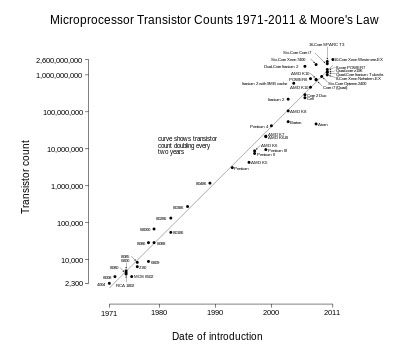
Calculating Infinity: The Paradox Of Moore's Law

" Moore’s law – the observation that the number of transistors in a dense integrated circuit doubles approximately every 18 to 24 months – is a projection and not a physical or natural law. Nonetheless, it has proved accurate for several decades, and has been used in the semiconductor industry to guide long-term planning and to set targets for research and development.

Many advances in digital electronics are strongly linked to Moore’s law: examples are quality-adjusted microprocessor prices, memory capacity, sensors and even the number and size of pixels in digital cameras.

But can this continue indefinitely? Intel stated in 2015 that the pace of advancement has slowed, starting at the 22nm feature width around 2012, and continuing at 14nm. However, in April 2016, Intel CEO Brian Krzanich stated that “In my 34 years in the semiconductor industry, I have witnessed the advertised death of Moore’s Law no less than four times. As we progress from 14nm technology to 10nm and plan for 7nm and 5nm and even beyond, our plans are proof that Moore’s Law is alive and well”.

Physical limits

Silicon-based technologies have nearly reached the physical limits of the number and size of transistors that can be crammed into one chip, while alternative technologies are still far from mass implementation. Down-scaling transistor size is more than an engineering challenge, as there is fundamental physics to consider.

Moore’s law would come to an end because transistors are as small as atoms and cannot be shrunk any further. To address this, fundamentally new concepts for electronics would be needed to produce commercially viable alternatives which meet demands for ever-growing computing power. Moore’s Law may become exhausted eventually unless new technologies come along that will lend it leash.

“The whole semiconductor industry wants to keep Moore’s Law going. We need better performing transistors as we continue down-scaling, and transistors based on silicon won’t give us improvements anymore,” said Heinz Schmid, a researcher with IBM Research GmbH at Zurich Research Laboratory in Switzerland.

Compound semiconductor materials

Schmid’s Zurich-based team with support from colleagues in Yorktown Heights, New York has developed a relatively simple, robust and versatile process for growing crystals made from compound semiconductor materials that will allow them be integrated onto silicon wafers – an important step toward making future computer chips that will allow integrated circuits to continue shrinking in size and cost even as they increase in performance.

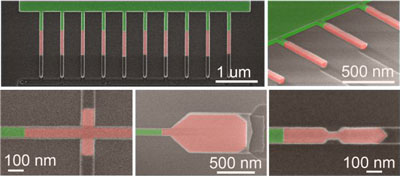
The IBM team has fabricated single crystal nanostructures, such as nanowires, nanostructures containing constrictions, and cross junctions, as well as 3-D stacked nanowires, made with so-called III–V materials. Made from alloys of indium, gallium and arsenide, III-V semiconductors are seen as a possible future material for computer chips, but only if they can be successfully integrated onto silicon. So far efforts at integration have not been very successful.

The new crystals were grown using an approach called template-assisted selective epitaxy (TASE) using metal organic chemical vapour deposition, which basically starts from a small area and evolves into a much larger, defect-free crystal. This approach allowed them to lithographically define oxide templates and fill them via epitaxy, in the end making nanowires, cross junctions, nanostructures containing constrictions and 3-D stacked nanowires using the already established scaled processes of Si technology.

“What sets this work apart from other methods is that the compound semiconductor does not contain detrimental defects, and that the process is fully compatible with current chip fabrication technology,” said Schmid. “Importantly the method is also economically viable.”

Spin not charge

One promising approach to developing new technologies is to exploit the electron’s tiny magnetic moment, or ‘spin’. Electrons have two properties – charge and spin – and although current technologies use charge, it is thought that spin-based technologies have the potential to outperform the “charge-based” technology of semiconductors for the storage and process of information.

Scientists from University College London (UCL) have discovered a new method to efficiently generate and control currents based on the magnetic nature of electrons in semi-conducting materials, offering a radical way to develop a new generation of electronic devices.

In order to utilise electron spins for electronics, or ‘spintronics’, the method of electrically generating and detecting spins needs to be efficient so the devices can process the spin information with low-power consumption. One way to achieve this is by the spin-Hall effect, which is being researched by scientists who are keen to understand the mechanisms of the effect, but also which materials optimise its efficiency. If research into this effect is successful, it will open the door to new technologies.

The spin-Hall effect helps generate ‘spin currents’ which enable spin information transfer without the flow of electric charge currents. Unlike other concepts that harness electrons, spin current can transfer information without causing heat from the electric charge, which – as mentioned above – is a serious problem for current semiconductor devices. Effective use of spins generated by the spin-Hall effect can also revolutionise spin-based memory applications.

The scientists have reported a 40-times-larger effect than previously achieved in semiconductor materials, with the largest value measured comparable to a record high value of the spin-Hall effect observed in heavy metals such as platinum. This demonstrates that future spintronics might not need to rely on expensive, rare, heavy metals for efficiency, but relatively cheap materials can be used to process spin information with low-power consumption.

Touch and Go
Overall, perpetuating Moore’s Law in the foreseeable future will require the development of disruptive technologies which take the electronics industry beyond its silicon comfort zone. Whether these can be developed in time for Moore’s Law to be maintained in the immediate future is touch and go, but even if not, there is no reason why it could not resume in the future"

Sphinx Logic A Microsoft Gold Partner. Now HPE

After graduating the Royal Society of the Arts this month I'm starting out on a new endeavor. A Shared Source Print Magazine. It it eventually will be a service in Microsoft's App Source and Apple News Stand. Our only competition currently in the world is the Green Coffee Agency. Starting out in Southwest Virginia. I'm summing up my family net worth with my father and what I've spent my time on the internet and on my computer the last 30 years. Also a UVA-Wise ISS Downlink. My favorite Professor was Arbar Qureshi Windows Server 2003 released on my birthday April 24th. and a famous reference source case at Microsoft.

  • Microsoft MSDN Subscriptions x6 they contain all of Microsoft client and server software plus development kits and acquired shared source, dating back to MS-DOS.
  • Apple MacOS X Panther, Snow Leopard and Lion. 
  • Autodesk Subscriptions x5 they contain all creator software. For games and film dating back to the original Autocad. 
  • Adobe Subscriptions x6 they contain all Illustration, graphic design, photography and publishing for print. Dating bate to Photoshop 5.5 and Macromedia Freehand 8.
  • The hardware over the years has cost about $30,000
  • The Macromedia licensed patent portfolio is valued at about $8 million.
  • Ran a successful Non-Employee Group out of San Fransisco, California for Macromedia from 1999-2005.
  • Revived National Science Foundation Grants for BOINC from 2002-present.
  • The HPE OpenVMS acquired shared source and IA64, Alpha and VAX.
  • The Shared Source System Integrator contract with Microsoft includes Windows NT 4.0,2000, XP, .NET Server.  And we are 1 and 150 in the world. Project OZ, Compact Embedded Shared Source versions, NT Curriculum. And research kernel for XP. 
  • Corporate university relations for Microsoft, Apple, Novell and IBM.
  • The internet and cable starting with Charter owned by AT&T which I've paid for 35 years. 
  • My RSA Fellowship which I've paid for for 8 years. 
  • My Social Media archives since 2008 or Microsoft collaborate knowledge work.
  • We've received Grants from the Bill and Melinda Gates Foundation at the Tennessee Applied Center for Technology, in 1999, Microsoft Bizspark 2009-2019 and Academic Azure Grant from 2023- present.
  • I'm Windows Internals, and 2003 Environment Certified and a University of Virginia Computer Science Graduate. With a 3.5 GPA Scholar Award and a ACT score of 24. I was UVa-Wise ACM Vice President of the Wise Chapter from 2009-2013. Member of the Microsoft MSDN Academic Alliance from 2001-2009 at the ACM.
  • My Microsoft 2008 SQL Server sales award.  
  • On my Royal Society of the Arts application is helped discover the Higgs Boson with BOINC and was accepted by then CEO Mathew Taylor.
  • Started SETI in 2002 with BOINC
  • My future Intel Partnership and Sponsor of my own Operating System.
  • A financial gift to the University of Washington. 
  • A 2012 80 GB Zune Microsoft gift from Microsoft's Jonathan Chang.
  • Hewlett Packard Enterprise $1 million dollar contract.the must be supported by local law enforcement.
  • Support the FreeBSD Foundation.

If the media needs proof just ask me.

My fathers contribution was his home, helped my on my credit Christmas, birthdays and groceries and thanks to my family at Eastman Chemical, The Freemason living across the street. and family in California and New York.. Looking for more shared source opportunities at Microsoft. I am a Windows seat at the .NET Foundation. I've paid my bills on time for 26 years. My family home is in Lowery Hills in Bristol, Va. I live downtown Abingdon, Va across the street from the state theater. 

During my RSA Fellowship I discovered. I have 7 hereditary titles in my family. I reported to the NIH about leukemia in America and requested economic sanctions against the Biden administration for economic terrorism at the state department. As the NIH dropped funding for the DSM-V. Reported the college board to the United Nations for the Microsoft Academic Program in 2001 for Windows 2000 source code and the Sept 11th bombings, War in Afghanistan and war in the Ukraine. Also the United States Governments break fix contracts. Reported Forbes Magazine to award them in journalism Office of the Federal Chief Sustainability Officer. I'm a member of the federalist party. I support UNESCO. My grandfather fraught in WWII in the US Navy. Boehm made source code capital. I support the journalist Carl Zimmer. I do not support the new cultural reset Microsoft 'Sun Valley' I'm on Windows 10 2019 LTSC until 2029. Also until the national interest reports on WWIII.

I've had problems with computer threat actors ever since I moved to Abingdon, Va in 2013, Filing a legitimate IRS form 1065 as a Microsoft Partner in 2011 with intangibles, People trying to steal my Microsoft Tender Offer in 2006. I have filed as dept of Virginia Housing discrimination lawsuit at Microsoft legal as a Royal Society of the Arts Fellow. And a Southwest Virginia psychosis diagnosis with cases pending at Microsoft legal. I do not support the church, basketball or football anymore because I haven't had a child and I'm 46. It's all a conspiracy for wealthy individuals to give back to there community after living in a home for 15 years. It's all about a 22 year old having a baby. That's just not evolution according to science. England used to have estates before WWII And Art Decko. Before the Beatles and James Taylor. We'll see what happens in 2029 or WWIII. I get a new drivers license in 2029.

I'm currently a Partner with Hewlett Packard Enterprise.which includes a Microsoft Partnership also in the Fidelity Money Market.